
Sharing radio communications with the next generation
Sharing radio communications with the next generation.
Perth, Western Australia, 21 February 2017 – In May 2016 Barrett Communications supplied the Rainbow Radio League, a not for profit organisation in St Vincent and the Grenadines, with high frequency (HF) and very high frequency (VHF) radio communications equipment. Since this time they have been working to install the donated equipment at key locations among the country’s islands.
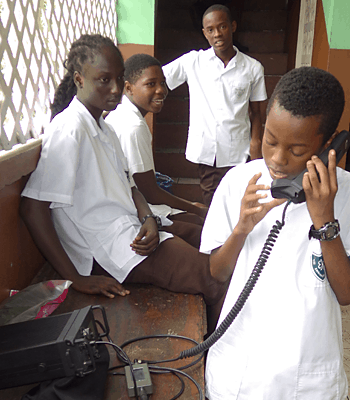
A unique project has recently developed with the aim to engage with the local high school students teaching them about the use of HF radio in an emergency and also as a hobby. Two schools, the JP Eustace Memorial Secondary School, (formerly Emmanuel High School – Kingstown) and Emmanuel High School – Mespo took part in this historic event. Mr Donald De Riggs, Director of Rainbow Radio League commented; “This was the first time that secondary schools here were involved in a wireless radio link up facilitated by the Rainbow Radio League Inc.”
At both schools Rainbow Radio League volunteers outlined the role of amateur radio as a service during times of national emergency. Mr Philip Greaves, Principal at Emmanuel High School – Mespo was involved with an actual demonstration using the Barrett 2090 manpack chatting with staff at JP Eustace Memorial Secondary School- Kingstown on the Barrett 2050 base station. Students were also involved with erecting the rapid deployment antenna as well as participating in the wireless ‘link-up’ between the two schools. The Rainbow Radio League Inc., is a non-profit, community service organisation with a special emphasis on emergency communications. The RRL Inc. operates VHF and HF wireless communications network in St Vincent and the Grenadines. For an island country that is within the identified “Hurricane belt” and lies on an active subduction zone, it is vital that this organisation and its volunteering members maintain the skills and interest in amateur radio. Mr De Riggs went on to say “It is anticipated that this will be an annual event, to eventually include all secondary schools.
Ham radio promotes goodwill and friendship among people, irrespective of nationality or race worldwide. In times of national emergency amateur radio is the main and, in most cases, the only means to communicate from the affected areas.”

Beyond the blackout: are power distributors underestimating the effectiveness of their backup communications?
When the power goes out, communication becomes everything.

Building a radio network for community-based environmental alerts
Learn how to build an HF radio network for community alerts. Explore emergency frequencies, training, and protocols to enhance disaster resilience

PACE comms strategy: Why HF radio is vital for emergency response
Choosing the right Primary, Alternate, Contingency, and Emergency (PACE) comms strategy is critical for improving the response to critical incidents.
Cognitive Radio: Smart Solutions for Spectrum Congestion
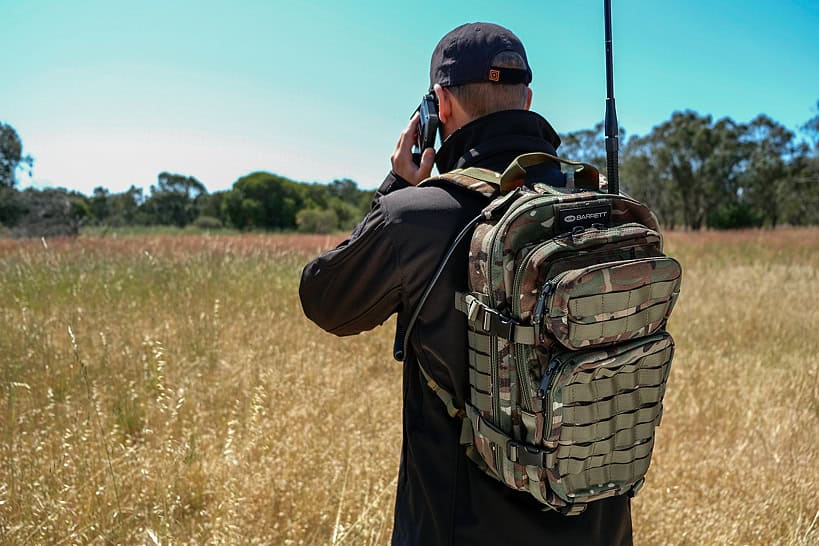
The surge in demand for wireless communication has led to significant spectrum congestion. Cognitive radio technology offers a smart solution to this problem by intelligently identifying and switching to available channels, enhancing spectrum efficiency and mitigating congestion.
Eliminating empty zones: Why HF radio remains critical in remote desert areas
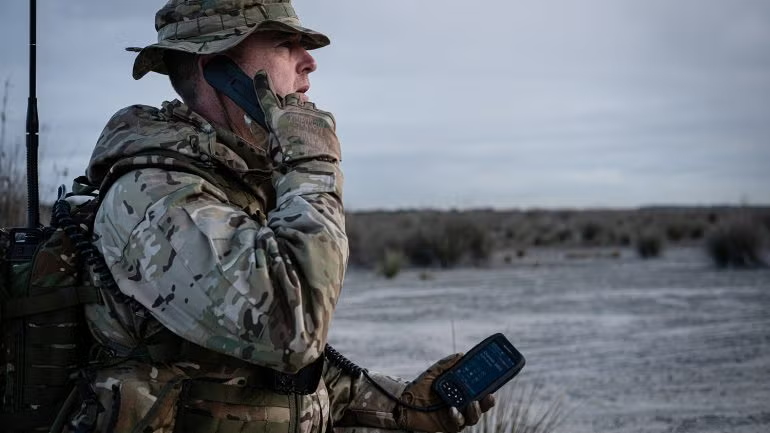
Securing reliable communications across vast desert areas that lack the necessary infrastructure can be complicated. In these so-called ‘empty zones’, which can extend for thousands of kilometres, alternative comms systems must be put in place to ensure vital personnel can remain in contact.
Advanced HF Radio Propagation Techniques: Mastering Long-Distance Communications
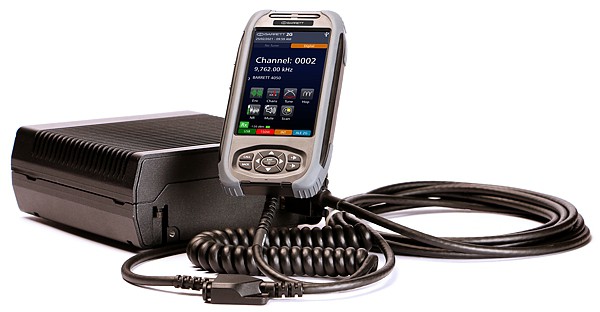
High-frequency (HF) radio wave propagation is crucial for long-distance communication.