
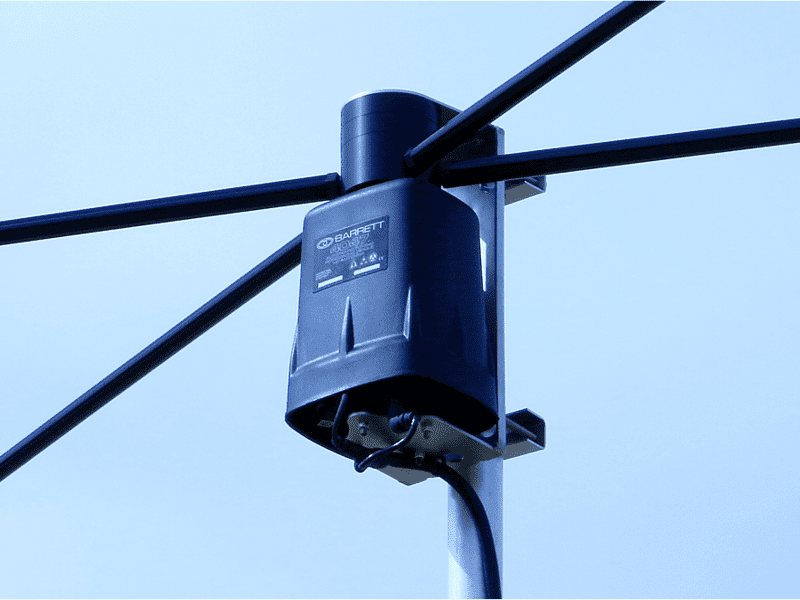
Antenna Series Part 3: When it comes to antennas, does size matter?
Antenna Series Part 3: When it comes to antennas, does size matter?
The different parts of antennas and how they relate to each other.
Antennas rely on size to be effective. This includes their height and length.
However, bigger isn’t necessarily better. For example, taller antennas don’t always have greater range than shorter ones.
In part 3 of our ongoing series on antennas, we’ll discuss the properties of antennas and how they relate to one another.
Explaining how antennas work
To understand how an antenna works, you need to grasp the relationship between its individual components. Here are a few general properties of antennas and what they mean:
Gain
When an antenna broadcasts a signal in any given direction, it transforms electricity into a radio wave. This is represented numerically in decibels (dB). How well an antenna is able to make that conversion is called gain.
You may find it a little confusing as to why decibels are used to measure this output, since an antenna doesn’t necessarily makes any sound at all. That’s because decibels do not, in fact, always measure loudness. Instead, decibels can represent various forms of power or amplitude.
Polarisation
Electromagnetic waves, such as radio waves, have an electric field and a magnetic field. These invisible fields are at right angles to each other. ‘Polarisation’ is the name given to the plane of the electric field component. Generally speaking for simple antennas the polarisation is the same as the physical orientation of the antenna. For example a vertical dipole produces a vertically polarised wave. A horizontal dipole produces a horizontally polarised wave.
Antennas that rely on propagation tend to exhibit horizontal polarisation to the sides of the antenna (along the X axis) and vertical polarisation along the axis of the antenna (Y axis). Therefore, for a signal to travel North/South, a horizontal antenna should be set up with the ends of the antenna pointing East/West.
Effective length
There’s a relationship between antenna length, frequency and wavelength. The length of the antenna is determined by how high the frequency is compared to the wavelength. There’s an inversely proportional relationship to the frequency and a directly proportional relationship to the wavelength which determines effective length.
This is perhaps best described as “Longer isn’t always better,” as the length of the antenna is unrelated to its power.
Wrapping it all up
There are many physical properties of antennas, but the biggest takeaway you should get from this article is that an antenna’s parts don’t reflect its power, at least not based on size alone. Instead, it’s the various relationships between the components that determine how effective a radio antenna is.
Tune in for more valuable information when part 4 of this series is released.
At Barrett Communications, we carry premium radios designed for the defense sector and private organisations. For example, our 4049 automatic tuning mobile HF antenna offer a 1.5 to 30 MHz frequency coverage and rapid tuning, typically under 1.5 seconds. Customisable with a waterproof and vibration- and impact-resistant antenna, the 4049 automatic tuning mobile HF antenna is tuned for performance. Contact us to learn more.

Beyond the blackout: are power distributors underestimating the effectiveness of their backup communications?
When the power goes out, communication becomes everything.

Building a radio network for community-based environmental alerts
Learn how to build an HF radio network for community alerts. Explore emergency frequencies, training, and protocols to enhance disaster resilience

PACE comms strategy: Why HF radio is vital for emergency response
Choosing the right Primary, Alternate, Contingency, and Emergency (PACE) comms strategy is critical for improving the response to critical incidents.

Cognitive Radio: Smart Solutions for Spectrum Congestion
The surge in demand for wireless communication has led to significant spectrum congestion. Cognitive radio technology offers a smart solution to this problem by intelligently identifying and switching to available channels, enhancing spectrum efficiency and mitigating congestion.

Eliminating empty zones: Why HF radio remains critical in remote desert areas
Securing reliable communications across vast desert areas that lack the necessary infrastructure can be complicated. In these so-called ‘empty zones’, which can extend for thousands of kilometres, alternative comms systems must be put in place to ensure vital personnel can remain in contact.
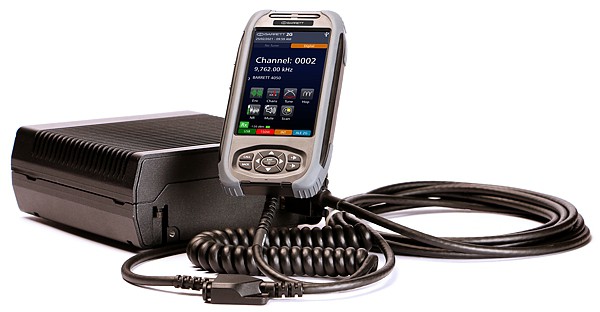
Advanced HF Radio Propagation Techniques: Mastering Long-Distance Communications
High-frequency (HF) radio wave propagation is crucial for long-distance communication.