

The Hollywood Origins of Frequency Hopping
The Hollywood Origins of Frequency Hopping
Frequency hopping is a method by which radio signals “hop” around a frequency in a pattern creating transmissions that are impossible to decipher from the outside.
The frequency shift is unfollowable to those without the correct algorithm. Whilst hopping at either 5 or 25 hops per second (depending on radio type and setting). This technology came from an unlikely source: the mind of movie star from the golden age of cinema, Hedy Lamarr.
Lamarr was born in Austria in 1914 and married a weapons manufacturer at 19. This gave her already inquisitive mind a foundation on which to build her invention. Throughout her glamourous Hollywood career, (Lamarr is best known for her role in 1949’s Samson and Delilah and believed to be the face of Disney’s Snow White and DC Comics Cat Woman) she experimented in her on-set trailer with equipment gifted to her by aviation eccentric Howard Hughes. Lamarr developed a faster, more aerodynamic wing design for his planes and he supported her inventing and experimenting wholeheartedly. So how did Lamarr end up developing frequency hopping?
It began with radio-guided torpedoes. As America prepared to enter World War II, Lamarr and fellow inventor George Antheil considered the problem of torpedo guidance being detected and/or jammed by the enemy. Lamarr developed the idea that a transceiver and receiver could rapidly shift frequencies in a pre-determined pattern which Antheil – a composer by trade – implemented as a musical melody (their frequency hopping had 88 frequency positions based on the 88 keys of a piano). They patented the idea in 1942. They offered it to the US Navy however it was rejected.
Despite this early rejection, frequency hopping was subsequently utilised by all US ships engaged in the Cuban Missile Crisis of 1962. Lamarr and Antheil never received any recognition or financial remuneration for their invention. Their invention went on to evolve into the technology behind Bluetooth and GPS. Lamarr and Antheil jointly received the Electronic Frontier Foundation’s Pioneer Award in 1997 and were both posthumously inducted into the National Inventors Hall of Fame in 2014.
All models in Barrett Communications’ HF Transceiver range can be equipped with a Frequency Hopping option which have been derived from the same theories pioneered by Lamarr in 1942. For HF radio communications, Frequency Hopping is one of the most effective electronic countermeasures still utilised in tactical applications today.

Beyond the blackout: are power distributors underestimating the effectiveness of their backup communications?
When the power goes out, communication becomes everything.

Building a radio network for community-based environmental alerts
Learn how to build an HF radio network for community alerts. Explore emergency frequencies, training, and protocols to enhance disaster resilience

PACE comms strategy: Why HF radio is vital for emergency response
Choosing the right Primary, Alternate, Contingency, and Emergency (PACE) comms strategy is critical for improving the response to critical incidents.
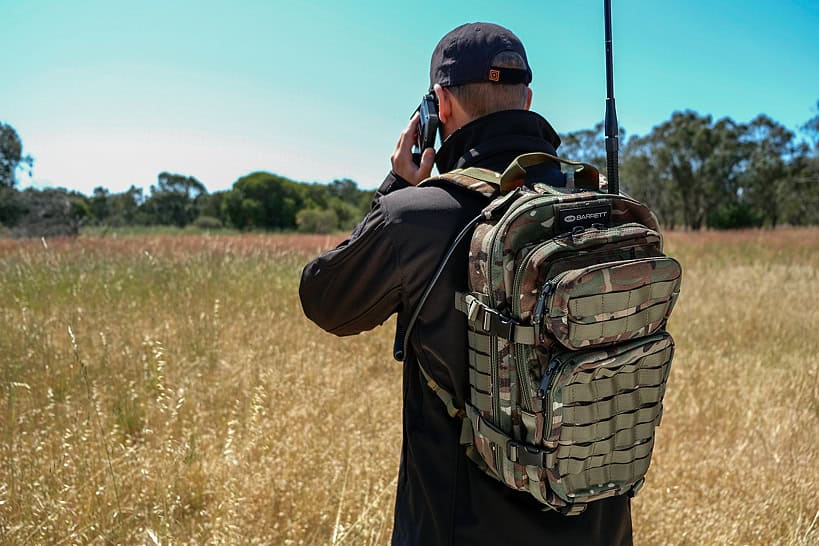
Cognitive Radio: Smart Solutions for Spectrum Congestion
The surge in demand for wireless communication has led to significant spectrum congestion. Cognitive radio technology offers a smart solution to this problem by intelligently identifying and switching to available channels, enhancing spectrum efficiency and mitigating congestion.
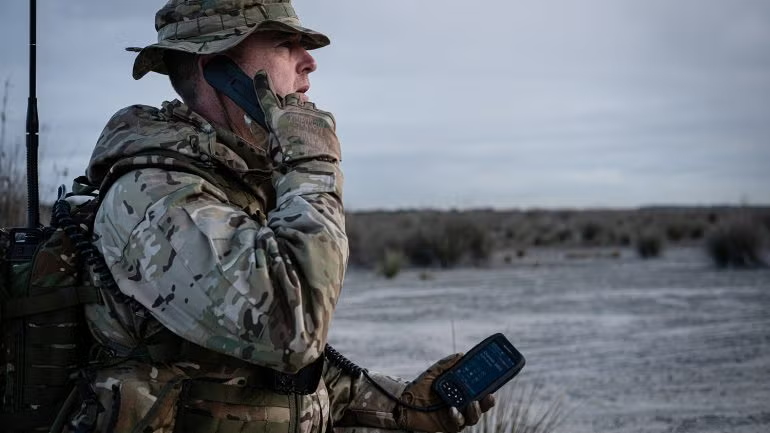
Eliminating empty zones: Why HF radio remains critical in remote desert areas
Securing reliable communications across vast desert areas that lack the necessary infrastructure can be complicated. In these so-called ‘empty zones’, which can extend for thousands of kilometres, alternative comms systems must be put in place to ensure vital personnel can remain in contact.
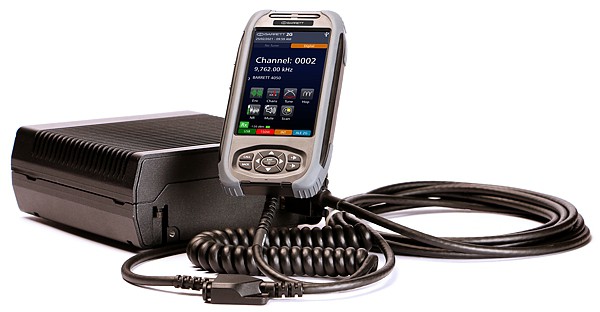
Advanced HF Radio Propagation Techniques: Mastering Long-Distance Communications
High-frequency (HF) radio wave propagation is crucial for long-distance communication.